Preschool English Classes in Singapore: Language and Literacy for K1, K2, and Early Learners
Quick Answer: Preschool English classes in Singapore serve children aged three to six (Nursery through K2) and focus on building oral language, phonological awareness, early phonics, and pre-writing skills through structured play, stories, songs, and guided conversation. The goal at this stage is not academic acceleration but laying the language foundation that makes Primary 1 English instruction accessible — a child who enters P1 with strong oral English, some letter-sound knowledge, and the ability to hold a pencil and form simple letters is well prepared for formal literacy instruction.
Many parents feel pressure to ensure their preschooler is reading independently before Primary 1. This is a misunderstanding of what matters at this stage. The research is clear: oral language development — vocabulary size, the ability to speak in complete sentences, the ability to retell a simple story in sequence — is a stronger predictor of later reading comprehension than early decoding. A K2 child who can talk confidently about a story they have heard is better positioned for P1 English than a child who can decode words mechanically but cannot discuss what they mean.
This guide explains what preschool English classes cover at each age, the role of play in language learning, what K1 and K2 learning goals look like, and how to choose a programme that builds the right foundation for Primary 1.
What Preschool English Classes Cover at Each Stage
Nursery (Ages 3–4): Oral Language and Phonological Awareness
At the Nursery stage, the priority is building spoken English — vocabulary, sentence structure, and the ability to listen and respond in a group setting. Phonics at this age is about phonological awareness: hearing and playing with sounds in spoken words, not learning letter symbols. Activities include nursery rhymes and songs (which build sensitivity to rhyme and rhythm), listening games ("Which word starts with the same sound as your name?"), and story time with discussion — "What do you think will happen next?" and "How does the character feel?"
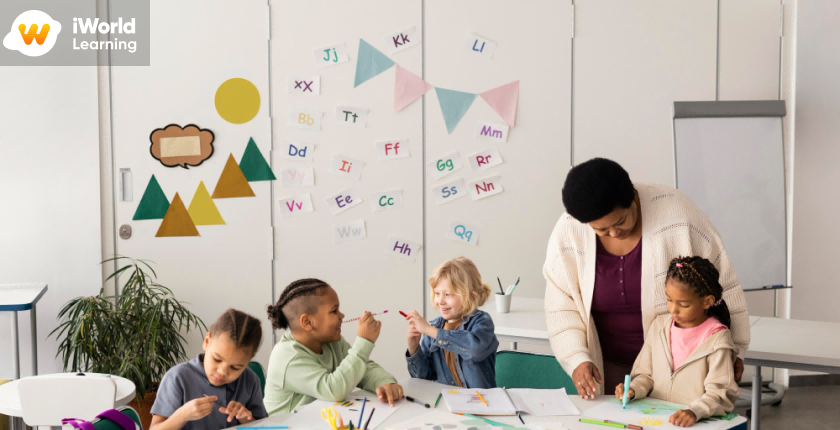
A quality Nursery English class looks more like guided play than formal instruction. Children learn through stories, songs, and structured conversation with the teacher and each other. Worksheets have no place at this stage — a three-year-old learns vocabulary and sentence patterns through interaction, not through tracing letters or filling in blanks.
K1 (Ages 4–5): Introducing Phonics and Pre-Writing
K1 is when systematic phonics instruction typically begins, starting with single-letter sounds and progressing to blending simple words (c-a-t → cat). Pre-writing skills develop alongside phonics — children practise the fine motor skills needed for handwriting through drawing, tracing shapes, and forming individual letters. Writing at the K1 level means being able to write one's own name, copy short words, and eventually write a simple sentence with support.
Oral language remains central at K1. Children should be speaking in complete sentences, engaging in back-and-forth conversation, and beginning to retell simple stories in sequence. A K1 child who arrives knowing lots of words but cannot yet sustain a conversation in English benefits more from oral language enrichment than from intensive phonics. Phonics builds on oral vocabulary — a child who can decode the word "enormous" but has never heard it used in conversation does not comprehend it.
K2 (Ages 5–6): Bridging to Primary 1
K2 is the bridge year. Phonics instruction continues with digraphs (sh, ch, th), consonant blends, and more complex vowel patterns. Children begin reading short decodable books independently. Writing progresses from single sentences to short connected texts — two or three sentences about a picture or an experience. The goal by the end of K2 is that the child can read a short, simple text with understanding and write a few sentences independently.
The gap to be aware of in K2 is comprehension. Many children enter K2 decoding well but understanding little of what they read. A K2 programme should devote as much time to talking about stories — characters' feelings, why events happen, what might happen next — as to sounding out words. This discussion-based comprehension work is what prepares children for the reading comprehension tasks they will face from P1 onwards.
Play-Based vs Academic Preschool English: Finding the Balance
Play-based language learning means children acquire English through activities they find intrinsically motivating — stories, songs, role-play, games, and art activities that involve speaking and listening. The teacher structures the play so that specific language targets are embedded in the activity. Academic instruction means direct teaching of skills — "today we are learning the sound /sh/" — followed by worksheet practice.
The best preschool English programmes use both, in a ratio of roughly 70% play-based to 30% direct instruction for Nursery and K1, shifting to about 50/50 by K2. A programme that is entirely play-based may not provide enough structured phonics for children who need it. A programme that is entirely worksheet-based is developmentally inappropriate for preschoolers and risks making English feel like a chore before formal schooling even begins.
When visiting a preschool English class, look for children who are engaged, talking, and moving — not sitting silently at desks completing worksheets. The room should be noisy with purposeful English use, not quiet with compliance.
Preparing for the Primary 1 English Transition
The jump from preschool English to Primary 1 is larger than many parents expect. In P1, children are expected to read short passages independently, write complete sentences, follow instructions in English, and participate in classroom discussions. The preschool years are the time to build the skills that make this transition manageable.
A preschool English programme that prepares children well for P1 does four things: it builds a large spoken vocabulary through rich conversation and story discussion, it provides systematic phonics instruction so children enter P1 able to decode unfamiliar words, it develops the fine motor control and letter-formation habits for handwriting, and it fosters a positive emotional relationship with English — the child associates reading and writing with pleasure and success, not anxiety. This fourth item is the one that worksheets-only programmes most often undermine.
Questions to Ask When Choosing a Preschool English Class
- What is the balance between play-based language development and direct instruction? (It should shift toward more direct instruction as the child moves from Nursery to K2.)
- What phonics approach do you use, and is it systematic? (Ask to see the scope and sequence.)
- How much of the lesson involves children speaking in English? (If the teacher talks for most of the lesson, language development is passive.)
- How do you assess progress, and how do you communicate it? (Look for observation-based assessment of oral language, not just worksheet scores.)
- How do you prepare K2 children specifically for the P1 English transition? (The answer should mention both literacy skills and learning behaviours — sitting, listening, following multi-step instructions.)
- What is the class size? (For preschoolers, 4–8 children per teacher is ideal for balancing individual attention with peer interaction.)
- Can my child attend a trial class before enrolling?
Summary
Preschool English classes build the oral language, phonological awareness, early phonics, and pre-writing skills that children need for a confident transition to Primary 1 English. The right programme balances play-based language development with systematic phonics instruction, shifts the ratio appropriately from Nursery through K2, and prioritises speaking and listening as the foundation for later reading and writing. Evaluate a class by the quality of children's engagement and spoken interaction, not by the quantity of worksheets produced.
FAQ
Should my preschooler be reading before Primary 1?
Not necessarily, but they should have emerging decoding skills — the ability to sound out simple three-letter words and read a short decodable text with support. More important than independent reading is oral language: a large vocabulary, the ability to speak in complete sentences, and the ability to understand and retell a story. These oral skills are stronger predictors of later reading success than early independent decoding.
What if my child does not speak much English at home?
A preschool English programme that prioritises oral interaction is especially important for children from non-English-speaking homes. The child needs structured opportunities to hear and use English in a setting where the teacher supports and extends their language. Small-group classes are more effective than large-group classes for this purpose because the child has more opportunities to speak and receive individual feedback. Consistent attendance — at least twice weekly — matters more than the total hours.
How do I know if a preschool English class is working?
Look for these signs over three to six months: your child initiates conversation in English more frequently at home, uses new vocabulary in context (not just repeating words from a list), shows interest in books and asks questions about stories, and begins to recognise letters and sounds in the environment (pointing to a sign and saying the first letter's sound). Avoid measuring progress only by worksheets or test scores at this age — preschool language development is best observed in natural communication.
Does iWorld Learning offer preschool English classes?
Yes. iWorld Learning's Preschool and Young Children English programme is designed for children aged three to six, combining play-based language development with systematic phonics instruction in small classes. Internationally certified teachers create a language-rich environment where children build speaking confidence, early literacy skills, and a positive relationship with English. Classes are held at the Tanjong Pagar and Somerset campuses, both conveniently located near MRT stations. Contact iWorld Learning to arrange a trial class and discuss which level matches your child's current stage.
相关文章
Recommended Reading
Popular Articles
-
English Teacher Salary in Singapore: A Complete 2026 Guide
-
The Ultimate english learning apps Bank: Categorized & Explained
-
British Council IELTS in 2026: What Changed, What It Costs, and How to Prepare
-
IELTS Price in 2026: What Test-Takers Actually Pay (And How to Spend Less)
-
The Complete 2026 Blueprint for O Level English Oral Topics 2026 Format & Strategy
-
IELTS Test Format, Scoring, and Key Changes for 2026 Explained
-
IELTS Exam Fee 2026: Complete Guide to Costs, Payment & Savings
-
PSLE 2026: Complete Guide to Exam Dates, Scoring System, and Preparation Strategies
-
IELTS Test Dates 2026: Monthly Schedule, Booking Strategy, and Prep Timeline
-
The Top 10 Tuition Centres in Singapore (2025) – A Curated Review for Parents & Students
latest articles
-
My Child Hates Writing: A Parent's Repair Plan
-
Primary English Tuition Fees in Singapore: Cost Drivers
-
Choosing a Primary 1 English Class in Singapore
-
Tuition Deposits and Notice Periods: A Parent Checklist
-
Helping With Composition at Home: Mistakes to Avoid
-
Synonyms for 'Nervous': Match the Word to the Worry
-
'Fleetwood' as a Family Name: Origin and Usage
-
PSLE Composition Ideas: Build a Story Bank That Works
-
PSLE AL Scoring: Plan Practice Around the Bands
-
One-to-One vs Group TOEFL Prep: Costs and Fit